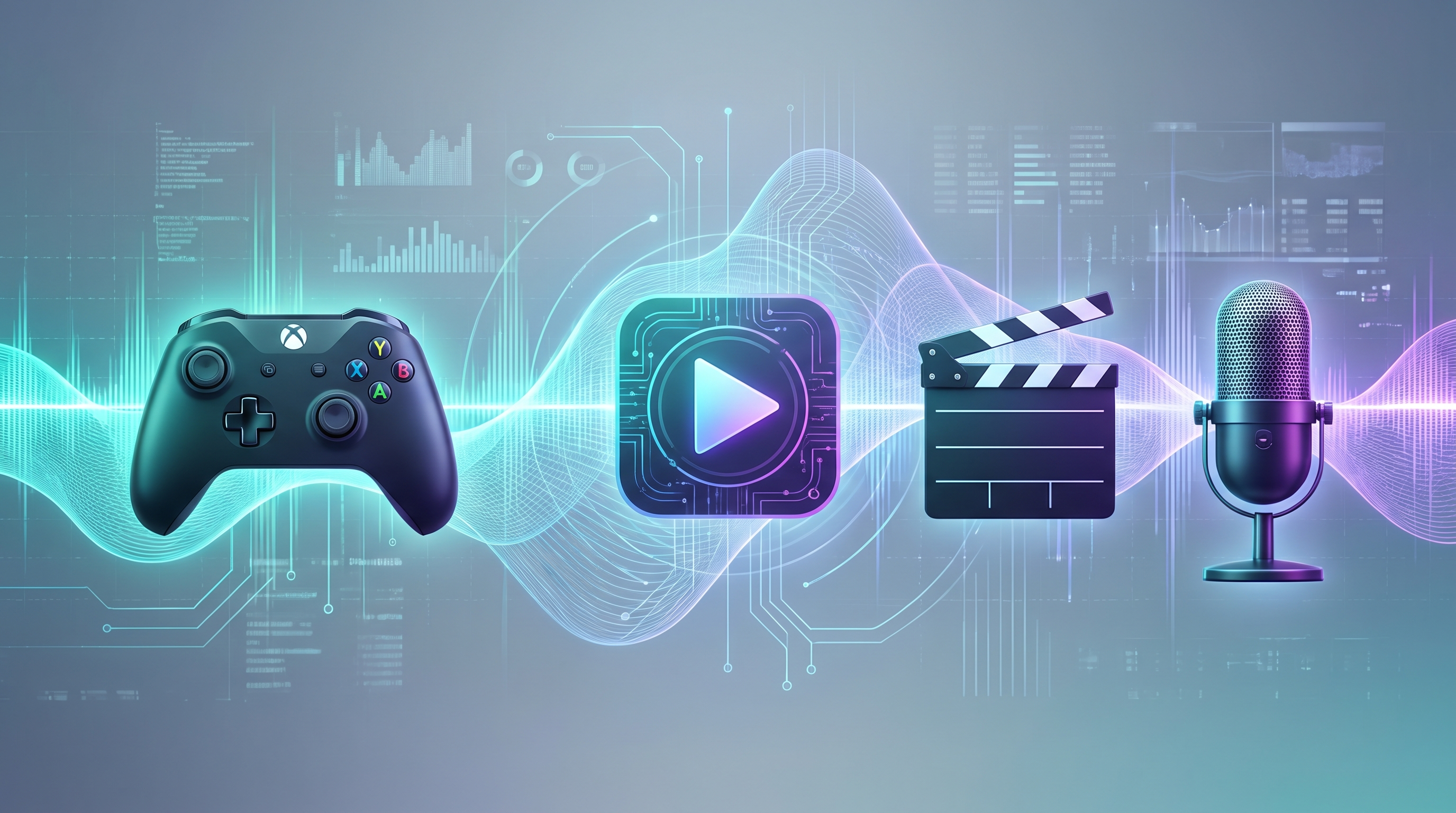
The entertainment industry in 2026 is a patchwork: billion-dollar franchises, indie podcasts, mobile games with million-player days, and brand films that debut on Instagram before TV. AI music sits in the middle—not replacing every composer, but filling gaps where volume, speed, and cost used to block ideas.
Streaming and serialized content Netflix-style doc series, true-crime podcasts, and YouTube investigative channels need hours of underscore that doesn't all sound identical. AI generates variant beds—tension, neutral exposition, hopeful resolution—so sound supervisors aren't stuck looping one stock track. Quality bar: consistent sonic palette per season, tagged explicitly so episodes feel cohesive.
Games and interactive entertainment From hyper-casual mobile to narrative indie on Steam, games need loops, stingers, and state changes. AI accelerates prototyping: menu theme today, boss fight bed tomorrow. Final shipping often still involves human polish, but pre-production moves faster when designers hear mood in-engine early. See our dedicated guide on game music for tag patterns.
Advertising and brand storytelling Agencies pitch three directions before lunch. AI music lets creative teams present distinct sonic territories—luxury minimal, playful ukulele, hybrid epic—without commissioning three composers upfront. Winning directions can be refined or handed to a music house for final master. Originality matters: brands hate sounding like every competitor's stock library.
Film and television Studio features still lean on composers and orchestras for flagship releases. Everything below that tier—student films, proof-of-concept sizzles, regional commercials, FAST channel filler— increasingly experiments with AI and hybrid workflows. Temp-to-picture is the gateway drug; some projects never leave AI when budget and genre fit.
Live events, sports, and esports Arena hype, broadcast packages, and esports interstitials need short, loud, identifiable cues. AI generates candidates fast; producers cut to picture and loudness specs. Loop-friendly tags help LED segments and replay montages.
Podcasts and audio fiction Intro/outro themes, mid-roll beds, and fiction podcasts with light scoring—all benefit from instrumentals tuned for voice-forward mix. Generate once, reuse with slight tag variations per season.
Where human composers remain essential Franchise themes that must last a decade. Scores with live soloists as emotional anchor. Union productions with fixed music department roles. Music that must align with complex live choreography. AI augments; it doesn't erase craft at the top of the industry.
Rights and professionalism Entertainment lawyers care about chain of title. Use platforms with clear commercial terms. Keep project notes: prompts, dates, versions. Don't impersonate famous scores or artists in prompts. For broadcast, sync, or theatrical, verify your license tier matches distribution.
AAiMusic in entertainment workflows Aria turns briefs into lyrics or instrumental direction. Full-song generation supplies vocals when characters or campaigns need them. Cover art aligns sonic and visual pitch decks. Listen pages give producers one URL for approval cycles across time zones.
Industry mindset Entertainment rewards reliability and taste. AI music is another production resource—like a great editor or a second camera. Teams that learn to direct it win schedules; teams that ignore it don't stop competitors from moving faster.
AAiMusic · Your imagination, your music
Keep reading
Related guides
 Industry & creators
3 min
AI Music for Indie Artists: Level the Playing Field
Why indie artists are turning to AI music—demos, full releases, and creative freedom without a big budget.
Read → Industry & creators
4 min
AI Music for Content Creators: TikTok, YouTube, Podcasts, and More
How creators use AI-generated music for Shorts, Reels, podcasts, and streams—workflow tips, quality checks, and why original AI tracks beat risky copyrighted clips.
Read → Industry & creators
3 min
AI Instrumentals: Background Music for Videos, Streams, and Projects
Create royalty-friendly instrumental beds with AI—tempo, mood, and genre tags that work for tutorials, games, and ambient content without vocals.
Read →