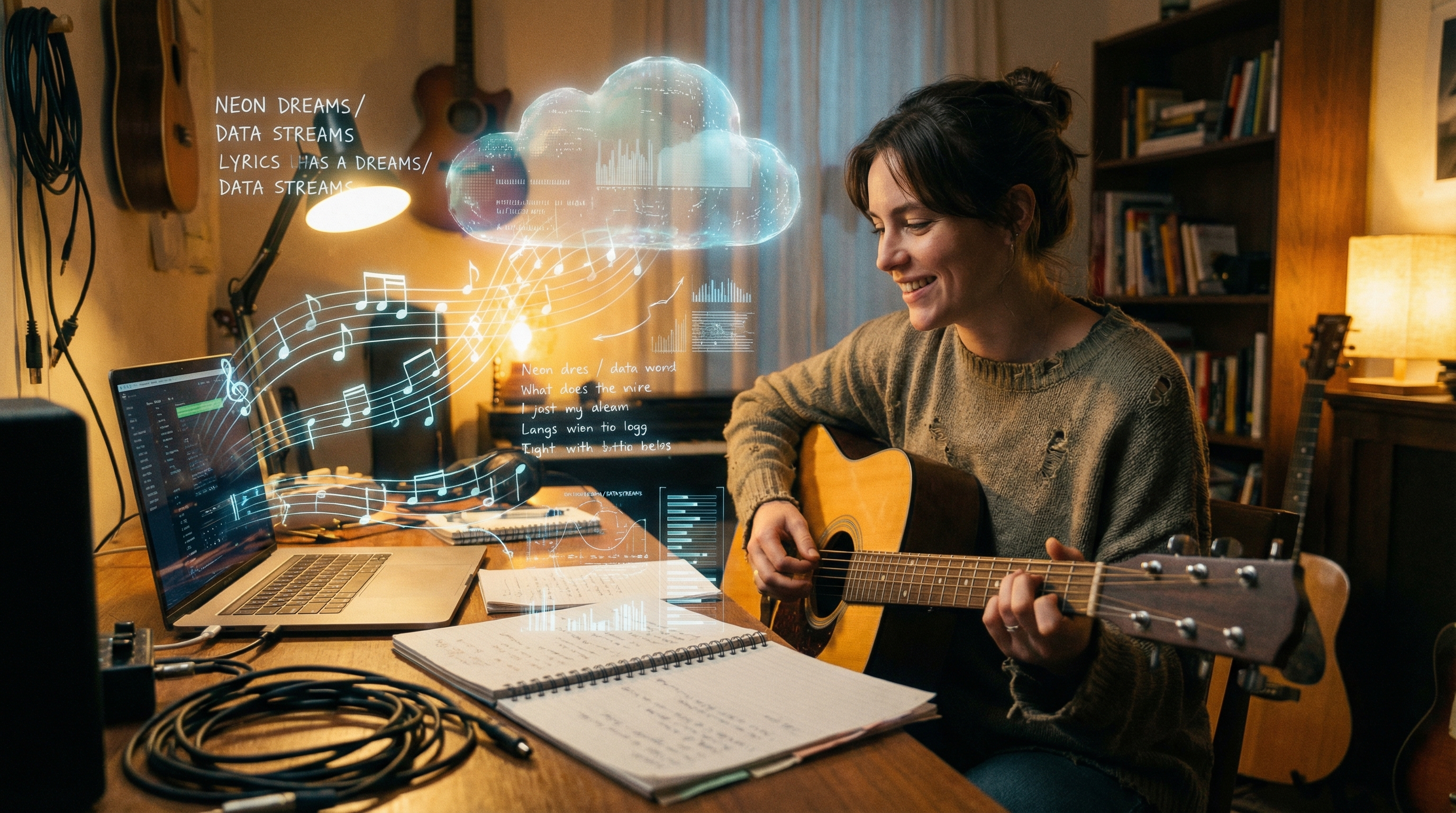
Something shifted in 2026: songwriting stopped feeling like a lonely blank page and started feeling like a session with someone who actually listens. AI isn't here to ghost-write your identity — it's here to help you move faster from spark to song, especially when you work with a creative partner like Aria on AAiMusic instead of a generic text box.
The blank page problem — solved differently Every writer knows the stall: you have a feeling, not a chorus. You have a title, not a verse. AI tools — used well — compress that stall from days into minutes. You describe the vibe ("upbeat birthday song for my best friend, 110 BPM pop"), and you get structure back: where a pre-chorus might land, how long lines should be, what rhyme scheme won't fight the melody. That's not cheating; it's the same thing co-writers have done in studio sessions for decades, except your co-writer never cancels on you.
Lyrics that actually work with AI music When your goal is a finished track, not just a poem, structure matters — but on AAiMusic you usually don't build it alone. Aria labels [Verse], [Chorus], and [Bridge] for you, adds style tags, and syncs everything to generate. If you write by hand, keep line lengths roughly consistent within a section; wildly uneven lines can produce vocals that feel rushed or dragged.
On AAiMusic, Aria sits in that loop with you. Paste a messy draft and ask for a punchier chorus — or just describe the moment and let her draft the whole thing. Tell her the song should feel more cinematic, more Afrobeats, more intimate. She suggests lines you can accept, edit, or ignore — but she keeps the conversation in your language, literally and creatively.
From idea to demo in one afternoon The old indie workflow: write → demo on guitar → forget the chord voicing → never finish. The 2026 workflow: talk to Aria → Generate track → hear the hook against real drums → say "punchier chorus" → regenerate. You're not skipping the craft; you're hearing sooner. Ear feedback is the best teacher, and AI music finally makes ear feedback cheap enough to iterate like a pro.
Collaboration, not replacement The writers winning with AI in 2026 aren't hiding it — they're directing it. They know what they won't compromise on (the story, the hook phrase, the emotional lie the song tells) and what they'll delegate (first-draft filler lines, alternate bridge ideas, five tag variations for mood). Think of AI as a room musician: helpful, fast, not the credited artist unless you want it to be.
Multilingual songwriting without losing nuance Global creators aren't translating word-for-word anymore — they're writing natively with assistants that understand Spanish phrasing, French cadence, Yoruba rhythm in the syllables. That matters for melody. A line that reads beautifully in English might sing awkwardly in Portuguese unless someone — or something — understands how vowels land in that language. Aria's multilingual strength is underrated here: you're not bolting translation onto an English song; you're starting in the language your audience lives in.
Studio tools extend the song, not the ego Once Aria helps you land a lyric and a generate pass you believe in, Studio picks up: extend for streaming length, reimagine for a social flip, language swap when the same heart needs a new home, duet when the story needs two voices. Songwriting doesn't end at the first MP3 — versioning is part of the job now, and AI makes versioning feel like creative choice instead of spreadsheet labor.
What to try this week Pick one real idea people actually make songs about — a birthday for someone you love, a hype track for the big game, a fun song for your coworkers, a love song for an anniversary. Open Create with Aria, chat until you're excited, hit Generate track once, listen on phone speakers, tell Aria one thing to change, try again if you want. Notice how fast your taste becomes the bottleneck — that's the point.
The bigger picture Songwriting in 2026 is more accessible and more competitive at the same time. The differentiator isn't who has access — everyone does — it's who has something to say and the workflow to say it before the moment passes. AI changes the how. You still own the why.
AAiMusic · Your imagination, your music
Keep reading
Related guides
 Songwriting
3 min
How to Write Lyrics for AI Music: Structure, Tags, and Tips
Lyrics for AI music work best with clear structure and style tags. This guide covers verses, choruses, bridges, and how to describe genre and mood so your AI song sounds exactly how you want.
Read → Songwriting
4 min
Meet Aria — Turn Your Imagination Into Music
Aria is your AI music partner on AAiMusic: co-write lyrics in your language, shape your sound, and turn what you imagine into songs you keep in your Library — not generic AI filler.
Read → Songwriting
3 min
How to Get Started with AI Music: A Beginner's Guide
New to AI music? Create your first song in minutes: chat with Aria, hit Generate track, and share from your Library. No lyric-sheet homework required.
Read →